Starting your first career after graduation can feel confusing. You may have a degree, but you may not know which career path offers the right combination of growth, learning, and opportunities.
HR Recruitment is one career path that freshers can consider, especially if you enjoy communicating with people, understanding job requirements, and connecting candidates with career opportunities.
The good news is that you don’t necessarily need years of experience to start learning recruitment. With the right skills, practical training, and job preparation, you can build a strong foundation for a career as a recruiter.
What Is HR Recruitment?
HR recruitment is the process of finding, evaluating, and hiring suitable candidates for job openings within an organization.
A recruiter acts as a bridge between the employer and the candidate.
The recruitment process can include:
- Understanding the job requirement
- Preparing or understanding the job description
- Searching for suitable candidates
- Sourcing candidates through job portals and LinkedIn
- Screening resumes
- Conducting initial candidate calls
- Coordinating interviews
- Following up with candidates
- Managing offers
- Following up until the candidate joins
Recruitment can involve hiring for different industries and roles, including IT, non-IT, healthcare, finance, engineering, sales, customer service, and many others.
Can a Fresher Become a Recruiter?
Yes.
Recruitment is a skill-based career where practical knowledge, communication skills, sourcing ability, and a good understanding of the hiring process can be extremely useful.
Employers may look for qualities such as:
- Good communication skills
- Confidence while speaking with candidates
- Basic understanding of recruitment
- Ability to understand job descriptions
- Candidate sourcing skills
- Good internet research skills
- Follow-up and coordination skills
- Basic knowledge of Excel or recruitment MIS
- Willingness to learn
A fresher who develops these skills can be better prepared to apply for entry-level recruitment positions.
What Skills Should You Learn?
1. Recruitment Fundamentals
Before learning advanced sourcing techniques, it is important to understand how recruitment works.
You should learn concepts such as:
- Recruitment lifecycle
- Internal and external recruitment
- IT and non-IT recruitment
- Job descriptions
- Candidate requirements
- Resume screening
- Shortlisting
- Interview coordination
- Offer management
- Joining follow-up
Understanding the complete recruitment cycle gives you a strong foundation.
2. Candidate Sourcing
Sourcing is one of the most important skills for a recruiter.
Recruiters need to identify potential candidates using different channels, including:
- Job portals
- Professional networks
- Recruitment databases
- Referrals
Learning how to search for the right candidate instead of simply waiting for applications can significantly improve your recruitment skills.
3. Boolean Search and X-Ray Search
Modern recruiters often use advanced search techniques to find relevant profiles.
Boolean search allows recruiters to combine keywords and search terms using operators such as:
AND, OR, NOT, quotation marks, and brackets.
X-Ray search can also help recruiters find relevant profiles and information through search engines.
These techniques are particularly useful when recruiting for niche or difficult-to-find positions.
4. Candidate Screening
Finding candidates is only the beginning.
A recruiter also needs to determine whether a candidate is suitable for a particular role.
Screening may involve checking:
- Skills
- Experience
- Education
- Location
- Notice period
- Salary expectations
- Relevant industry experience
- Communication skills
- Job requirements
Recruiters should learn how to compare a candidate’s profile with the actual requirements of the position.
5. Candidate Calling and Communication
Communication is a major part of recruitment.
Recruiters may speak with candidates throughout the hiring process, from the initial screening call to interview coordination and joining follow-up.
A recruiter should learn how to:
- Introduce themselves professionally
- Explain the job opportunity
- Ask relevant screening questions
- Understand candidate expectations
- Handle candidate objections
- Schedule interviews
- Follow up professionally
Strong communication can make a significant difference in a recruiter’s career.
6. End-to-End Recruitment
Once you understand individual recruitment activities, the next step is understanding the complete process.
A typical recruitment workflow can look like:
Requirement → Sourcing → Screening → Candidate Calling → Interview → Feedback → Offer → Joining
Learning this complete workflow helps you understand what recruiters actually do on a day-to-day basis.
What About UK and European Recruitment?
Recruitment is not limited to the Indian market.
Recruiters can also develop knowledge of international recruitment processes, including UK and European recruitment.
International recruitment may involve learning about:
- UK recruitment terminology
- UK CV formats
- International sourcing
- Job portals
- Boolean and X-Ray search
- Candidate screening
- Interview coordination
- Recruitment communication
- Offer and onboarding processes
- Awareness of right-to-work requirements
- Data privacy considerations
Learning international recruitment can help recruiters understand how hiring processes differ across markets.
How Can AI Help Recruiters?
Artificial Intelligence is becoming increasingly useful in recruitment.
Recruiters can use AI tools to assist with tasks such as:
- Creating job descriptions
- Improving recruitment emails
- Preparing screening questions
- Generating interview questions
- Organizing candidate information
- Creating sourcing strategies
- Improving communication
- Building recruitment workflows
However, AI should be treated as a support tool, not a replacement for recruiter judgment.
Recruiters still need to understand candidates, job requirements, communication, hiring processes, and employer expectations.
Do You Need a Recruitment Course?
You can learn recruitment independently through online resources and practical experience.
However, structured training can help you learn the recruitment process in a more organized way.
A practical recruitment training program should ideally cover:
- Recruitment fundamentals
- Candidate sourcing
- Job portals
- LinkedIn sourcing
- Boolean search
- X-Ray search
- Resume screening
- Candidate calling
- End-to-end recruitment
- UK recruitment
- European recruitment
- AI tools for recruiters
- Practical recruitment projects
- Interview and job preparation
For freshers, practical exposure is particularly important.
Simply knowing recruitment terminology is different from actually working through a recruitment requirement from sourcing to joining.
What Career Opportunities Are Available?
After developing recruitment skills, you can explore entry-level roles such as:
- HR Recruiter
- Talent Acquisition Executive
- Recruitment Executive
- Recruitment Consultant
- Talent Acquisition Associate
- IT Recruiter
- Non-IT Recruiter
- International Recruiter
- Recruitment Coordinator
With experience, recruiters can progress into senior recruitment, talent acquisition, recruitment consulting, sourcing, team leadership, or specialized international recruitment roles.
How Talentiaa IQ Can Help
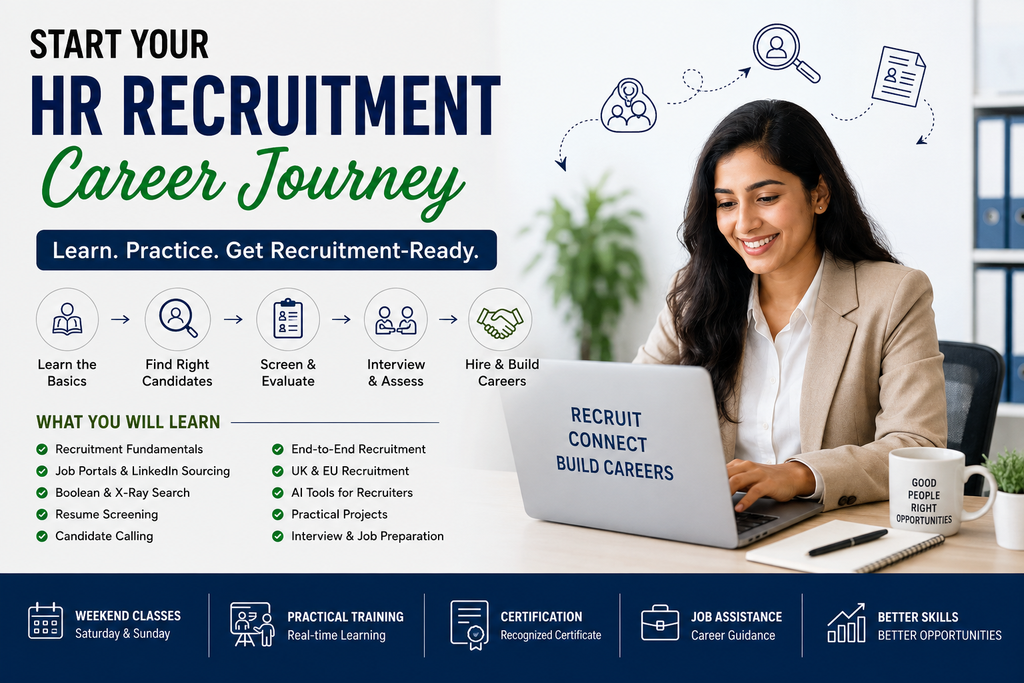
At Talentiaa IQ, our HR Recruitment Training programs are designed for freshers, graduates, students, and individuals looking to build a career in recruitment.
Our training focuses on practical recruitment skills, from the fundamentals of hiring to sourcing, screening, end-to-end recruitment, international recruitment, and AI tools for recruiters.
Training programs are conducted on weekends, making them suitable for students and working professionals.
Programs include:
- Recruitment Foundation – 2 Weeks
- Professional Recruiter – 4 Weeks
- International Recruiter – 6 Weeks
- HR Recruitment Career Program – 12 Weeks
Programs include practical learning, certification, career guidance, and job assistance.
Start Building Your Recruitment Career
You don’t need to know everything before starting.
The first step is to understand the recruitment process, develop practical skills, and consistently improve your communication and sourcing abilities.
If you’re a fresher or graduate interested in building a career in HR recruitment, structured practical training can help you understand what recruiters actually do and prepare you for recruitment opportunities.
Ready to start your HR recruitment journey?
Explore Talentiaa IQ’s HR Recruitment Training programs and choose the program that matches your career goals.
Talentiaa IQ – Learn Recruitment. Build Skills. Grow Your Career.
Note: Job assistance and career guidance do not guarantee employment or placement. Final hiring decisions depend on employer requirements, candidate qualifications, skills, interview performance, and other selection criteria.